
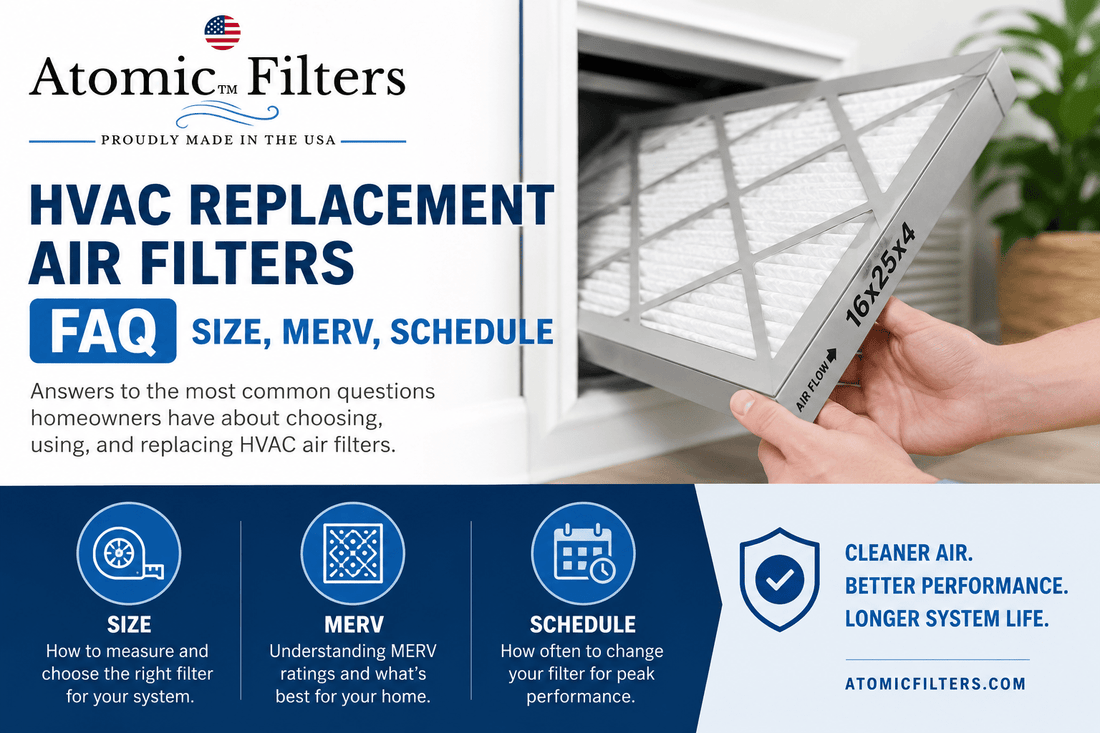
HVAC Replacement Air Filters FAQ: Size, MERV, Schedule
Most homeowners buy HVAC replacement air filters the same way they buy lightbulbs: grab whatever looks close enough and hope for the best. The problem is that a wrong filter choice does more than hurt air quality. It can strain your system, spike your energy bill, and shorten the lifespan of equipment that costs thousands to replace.
The real challenge isn't finding a filter. It's knowing which MERV rating actually makes sense for your home, whether aftermarket options match OEM quality, and how often you truly need to swap out a dirty filter. This guide answers those questions with clear recommendations you can act on today.
How to Choose the Right HVAC Replacement Air Filter for Your System
Picking the right filter comes down to three decisions in this exact order: size, MERV rating, and filter type. Getting the size wrong makes everything else irrelevant, so start there.
Find Your Exact Filter Size First
Pull out your current filter and look for printed dimensions on the frame. You'll see something like 16x25x4 or 20x20x1. These numbers represent length, width, and thickness in inches.
If the print has worn off, measure the filter yourself. Use a tape measure on all three dimensions and round to the nearest inch. A common mistake is buying "nominal" size when you need "actual" size, or vice versa. Nominal dimensions are the rounded marketing numbers on the label, while actual dimensions run slightly smaller. Most retailers sell by nominal size, so use those numbers when ordering. For a deeper walkthrough on sizing, the HVAC filter sizing and measuring guide breaks down the process with charts.
One more thing: check the airflow arrow printed on your current filter before removing it. That arrow should point toward the blower motor. Install the new filter the same direction.

A MERV Rating Guide Homeowners Can Actually Use
MERV stands for Minimum Efficiency Reporting Value, and it ranges from 1 to 20. Higher numbers trap smaller particles. But in a thin 1-inch filter that isn't always true, and this is where most people get tripped up. What actually drives airflow resistance is filter depth, not the MERV number: in a deep 4–5 inch media cabinet, the extra pleated surface area lowers resistance, so even a MERV 16 runs freely with no airflow penalty.
With a thin 1-inch filter, residential HVAC systems typically handle MERV ratings between 8 and 13. Go above MERV 13 in a 1-inch slot without confirming your system supports it, and you risk restricting airflow, which forces the blower to work harder, increasing energy costs and potentially causing compressor damage over time. That caution applies only to thin filters: in a deep 4–5 inch media cabinet the larger pleated surface area lowers resistance, so even MERV 16 flows freely without an airflow penalty.
MERV Rating |
What It Captures |
Best For |
|---|---|---|
MERV 8 |
Dust, pollen, dust mites |
Standard homes without pets or allergy concerns |
MERV 11 |
Pet dander, mold spores, smog particles |
Homes with pets or mild allergy sufferers |
MERV 13 |
Bacteria, smoke particles, fine allergens |
Allergy-heavy households or areas with wildfire smoke |
MERV 8 vs. MERV 11 vs. MERV 13: Which One Should You Pick?
MERV 8 is the default recommendation from Consumer Reports for most homes, and honestly, it handles the job well if you have no pets and no one in the house deals with respiratory issues. It catches common household dust and pollen at a low price point.
MERV 11 hits a sweet spot for pet owners. It captures dander and finer mold spores without creating noticeable airflow resistance in most standard systems. If you have a dog or cat, start here.
In a 1-inch filter, MERV 13 is the highest rating we'd recommend without checking your system's specs first. It's excellent for allergy sufferers and smoke-prone areas, but in thin 1-inch media some older furnaces or single-speed blower motors struggle with the denser pleats. If you're limited to a 1-inch slot, check your HVAC manual or call your technician before jumping to MERV 13. In a deep 4–5 inch cabinet that concern goes away, since the added surface area lets even high MERV run at low resistance. For a detailed comparison with specific filter examples, the MERV 8 vs. 11 vs. 13 breakdown covers performance differences in real-world conditions.
HVAC Filter Replacement Schedule: How Often Should You Change Your Filter?
The generic advice of "every 90 days" is fine as a starting point. But your actual schedule depends heavily on filter thickness and household conditions.
Replacement Timing by Filter Thickness
Filter Thickness |
Standard Home |
With Pets or Allergies |
Heavy Use or Poor Air Quality |
|---|---|---|---|
1 inch |
Every 30–60 days |
Every 20–30 days |
Every 20 days |
2 inch |
Every 60–90 days |
Every 30–60 days |
Every 30 days |
4 inch |
Every 6–9 months |
Every 4–6 months |
Every 3–4 months |
5 inch |
Every 9–12 months |
Every 6–9 months |
Every 4–6 months |
Thicker filters hold more debris before airflow drops, which is why a 4-inch HVAC filter lasts several times longer than its 1-inch counterpart. If your system accepts thicker filters, switching from 1-inch to 4-inch saves you both hassle and money over the year.
When Pets, Allergies, and Smoke Change the Schedule
Two large dogs in a 1,200-square-foot home will clog a 1-inch filter in under three weeks. That's not an exaggeration. Pet hair and dander accumulate fast, especially during shedding season.
Wildfire smoke and nearby construction dust also accelerate replacement. During California's fire season or after a home renovation, check your filter weekly regardless of thickness. If you hold the filter up to light and can't see through the pleats, it's done.
Allergy sufferers benefit from both a higher MERV rating and a shorter replacement cycle. Dirty filters stop trapping new allergens and start releasing trapped particles back into your air. For step-by-step replacement instructions, the furnace filter replacement walkthrough covers the process for standard and deep-pleat models.

Signs Your HVAC Filter Needs Changing Sooner Than Expected
Don't rely solely on calendar reminders. Your filter sometimes gives clear signals before the scheduled swap date.
Dust building up on furniture faster than normal is the most obvious one. If you're wiping surfaces every couple of days and they're still dusty, your filter has probably hit capacity. Reduced airflow from vents, a musty smell when the system kicks on, and increased allergy symptoms indoors all point to the same problem.
One underrated warning sign: your energy bill creeping up without an obvious cause. A clogged filter forces the blower motor to draw more power, and that shows up on your utility statement. Swapping in a fresh furnace air filter is the cheapest HVAC troubleshooting step you can take.
OEM vs. Aftermarket Air Filters: Do You Really Need the Brand Name?
Short answer: no. Aftermarket furnace air filters that match your system's dimensions and MERV rating perform identically to OEM versions in almost every measurable way. The filter media, frame construction, and pleat count matter far more than the logo stamped on the box.
Why Aftermarket Filters Cost Less Without Cutting Corners
OEM filters carry a brand markup because you're paying for the Carrier, Lennox, or Honeywell name. Aftermarket manufacturers produce compatible filters using the same materials and filtration standards but sell direct or through focused retailers, eliminating layers of markup.
Atomic Filters, for example, offers replacements compatible with major brands at up to 40% less than OEM pricing. Same MERV ratings, same dimensions, same pleated media. The savings add up quickly when you're buying multiple filters per year, especially for property managers handling several units. A Honeywell 20x25x4 MERV 13 replacement is a good example: identical fitment at a fraction of the branded price.
The one exception worth noting: if your system is under warranty and the manufacturer explicitly requires OEM filters (rare but possible), check your warranty terms first. Most warranties don't restrict filter brand as long as you use the correct size and rating.
What Aftermarket Savings Actually Look Like Over a Year
Consider a household running a standard system with a 4-inch filter replaced every six months. An OEM filter might cost $35–$45 each, while an equivalent aftermarket option runs $20–$28. That's roughly $30–$40 saved annually on a single unit.
Now multiply that across a small rental portfolio of five or ten properties. A property manager replacing filters in ten units twice a year saves $300–$400 annually. That's real budget recovered just by switching brands. Grand View Research estimates the HVAC filters market was valued at $7.43 billion in 2025, and aftermarket options continue to grow their share precisely because consumers and businesses recognize the value gap.
High Efficiency Home Air Filters Without Airflow Problems
The pursuit of cleaner air leads some homeowners to buy the highest MERV filter they can find. In a thin 1-inch filter slot, this backfires more often than you'd expect.
High efficiency home air filters in the MERV 14–16 range only cause trouble when they're crammed into a thin 1-inch slot. In that thin format the dense media creates excessive static pressure, reduces airflow across the evaporator coil, and can freeze your AC in summer. The real culprit is depth, not the MERV number: in a deep 4–5 inch media cabinet the same high efficiency runs freely. An Atomic 20x25x5 MERV 16, for instance, tested at roughly 0.07 in. w.c. at 1,024 CFM — lower than a 5-inch MERV 11 (0.08) or MERV 13 (0.10), and far below a 1-inch MERV 13 (about 0.30) — so even MERV 16 carries no airflow penalty in a deep cabinet. Consumer Reports published a buying guide recommending that homeowners default to MERV 8 pleated filters as a safe starting point, stepping up only when the system supports it.
If you want better filtration without risking airflow problems, increase filter thickness rather than MERV rating. A 4-inch MERV 11 filter provides better total particle capture than a 1-inch MERV 13 because it has more surface area and deeper pleats. The thicker media handles the same MERV level with less resistance.

How the Right Filter Protects Both Air Quality and Your HVAC System
Your filter doesn't just clean the air you breathe. It also protects the internal components of your HVAC system from dust buildup. Dirt on the evaporator coil reduces heat transfer efficiency. Debris in the blower wheel creates imbalance and wear. A clean, properly rated filter prevents both problems simultaneously.
Running the system without a filter, or with a filter that's too thin and loose-fitting, lets particles bypass the media entirely. Those particles coat the coil, clog the condensate drain, and eventually lead to service calls that cost far more than a year's worth of filters.
For homeowners thinking about filter replacement as pure expense, reframe it as insurance. A $25 filter every six months protects a $5,000–$10,000 system. The math speaks for itself.
Frequently Asked Questions
Q: Can I use washable or reusable HVAC filters instead of disposable pleated filters?
A: Washable filters can work for some systems, but they often trade convenience for lower filtration performance and can be easy to reinstall while still damp. If you want a reusable option, confirm it is designed for your exact filter slot and that it will not increase airflow resistance beyond what your system can handle.
Q: How do I know if a filter is too restrictive for my HVAC system?
A: Warning signs include noticeably weaker airflow, rooms taking longer to heat or cool, and the system running longer cycles than usual. When in doubt, verify the maximum recommended filter rating in your equipment documentation or ask an HVAC technician to check static pressure.
Q: Does a higher pleat count always mean better filtration?
A: Not necessarily, pleat count affects surface area and dust holding capacity, but media quality and construction matter just as much. Look for consistent pleat spacing, sturdy frames, and reputable performance specs rather than using pleat count as the only deciding factor.
Q: Are electrostatic filters worth it for homes with lots of dust?
A: Electrostatic filters can help attract particles, but performance varies widely by design and how well they maintain airflow over time. Compare verified efficiency claims and consider whether a deeper pleated filter provides a more predictable balance of filtration and airflow.
Q: What is the difference between a return vent filter and a filter at the air handler or furnace?
A: Some homes filter air at the return grille, others at the equipment cabinet, and some setups use one or the other. Use only the filtration points your system is designed for, adding extra filters can reduce airflow and strain the blower.
Q: How should I store replacement HVAC filters so they do not get damaged?
A: Keep filters in their original packaging, stored flat in a clean, dry area to prevent warping and moisture exposure. Avoid garages or basements with high humidity or heavy dust, since the filter media can absorb odors and debris before installation.
Q: Should I use different filters during allergy season or wildfire season?
A: Many households benefit from a seasonal approach, using a more protective option when airborne irritants spike, then returning to a standard filter later. Before changing filtration strategy, confirm your system can support the chosen filter without reducing airflow or comfort.
Choose Your Next Filter with Confidence
Getting HVAC replacement air filters right doesn't require an engineering degree. Measure your current filter, match the MERV rating to your household's actual needs, and replace on a schedule adjusted for your home's conditions. Thicker filters save trips and money. Aftermarket options deliver the same performance at a lower cost.
Atomic Filters carries compatible replacements for Carrier, Lennox, Trane, Honeywell, and other major systems, with fast shipping and over 4,100 customer reviews backing their quality. If you know your size and MERV rating, browse the full selection at atomicfilters.com and get the right filter delivered before your next change date.